Aumla Winning with Wellbeing
Health factors at work – the path to wellbeing and productivity
Gyms, massages and wellness allowances have their place – but what really makes us thrive at work is how the work is organised. Ann-Sofie Forsmark on health factors and a sense of coherence.
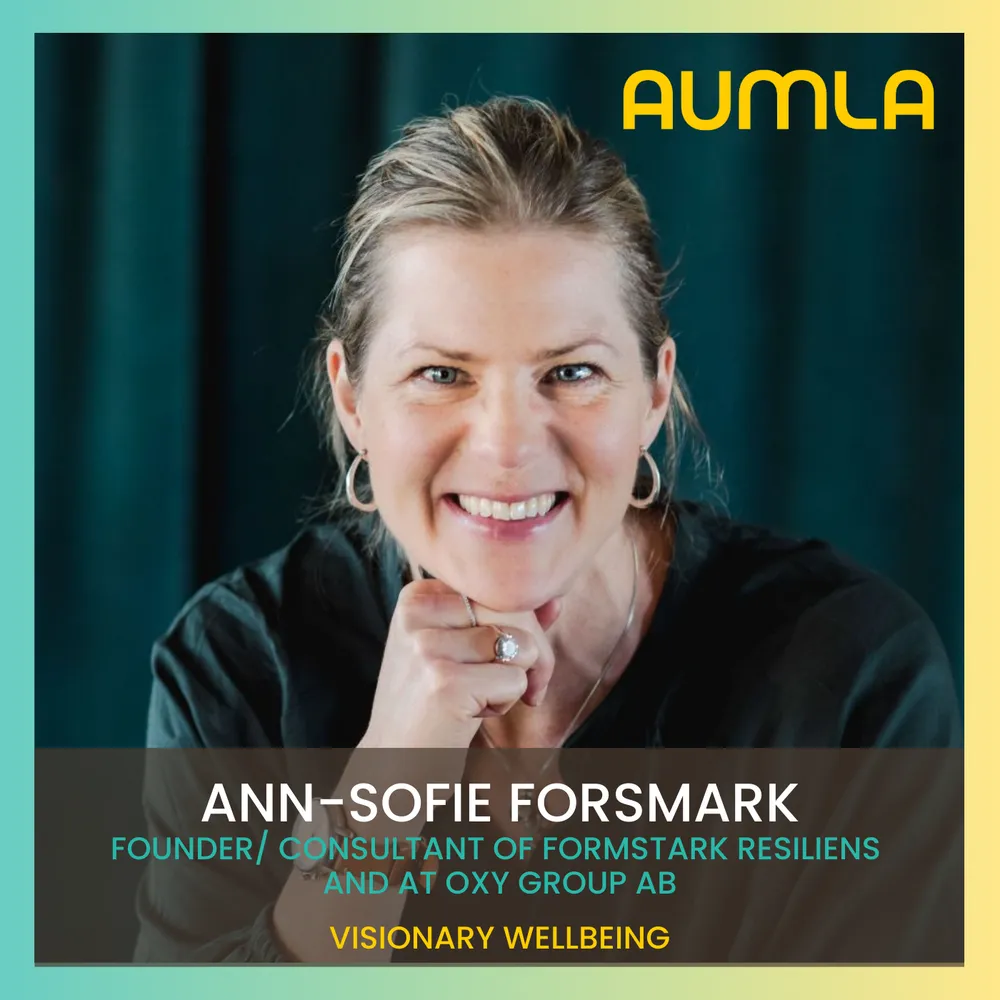
Ann-Sofie ForsmarkWorkplace health and work environment expert, author
The conversation is in Swedish.
From personal training to organisational health
Ann-Sofie Forsmark started in personal training and health coaching, but when she began working with workplace health in London in 1999, a question took hold: what happens at work that makes people feel the way they do? Today she is a business graduate with further training in work environment, behaviour change and health psychology, and works with leadership teams, managers and employees across all kinds of organisations. She is the author of KASAM på jobbet (Sense of coherence at work).
What does the organisation gain from health?
The short answer: a lot. Research shows higher efficiency and productivity, more engagement, happier customers and employees who stay. The challenge is that large calculated figures feel abstract – and investing in wellbeing requires pausing, which organisations are rarely good at.
Miriam stresses starting from data: analysing the current situation and following it over time, so limited resources go to the right things rather than to one-off talks that are impossible to evaluate.
Sense of coherence
Sense of coherence (KASAM in Swedish) is a model from research on people who came through extreme situations – and it works just as well at work. We thrive when we experience:
- Meaningfulness – I want to, and my work matters
- Comprehensibility – I understand what is happening, why I do my tasks and why we are changing
- Manageability – there are external resources, such as social support and a good physical environment, and I have the inner resources to handle the situation
Meaningfulness is not carried by the task alone, but also by respectful treatment, fairness and good relationships. And strengthening one part – comprehensibility through feedback, for example – often lifts all of them.
Dare to invest in health by making the work itself health-promoting.
Wellness perks or health factors?
- Wellness perks are aimed at the individual, voluntary and often sit on top of the work – fitness allowances, talks, yoga classes. What people ask for in surveys is not always what they use.
- Health factors are about how work is organised, leadership, culture and values. They affect us in every part of the working day – especially our mental and social wellbeing.
Ann-Sofie wants employers who, when asked what do you do for health?, answer: we have a wellness allowance – but what we really want to talk about is how we work together, how we lead and how we create clarity. Physical health can be built into the work too, with walk-and-talks and breaks between meetings.
The health factors
The Swedish organisation Suntarbetsliv lists eight health factors, and Ann-Sofie adds two:
- A fair and transparent organisation
- Present, trusting and engaged leadership
- Participation and influence
- Communication and feedback
- Prioritisation of tasks
- Skills development throughout working life
- Systematic work environment management in everyday work
- Early interventions
- Clear goals
- Well-motivated changes
No workplace scores top marks on all of them. Using an employee survey as a starting point, leadership teams can see where an initiative will have the most impact – and because the factors are connected, improving one often improves several.
The individual’s responsibility
The organisation should create the conditions – but individuals have a responsibility too: to find out what they need to do a good job, ask for it, ask questions that create clarity and take care of themselves, for example by suggesting a break in a long meeting.
A concrete tip when your role has become unclear: go to your manager and say this is how I plan to prioritise – can you confirm that? And learn to let go of work when you go home. According to Ann-Sofie, that is one of our most important skills.
How do you measure impact?
Start from the KPIs leadership already cares about, and link initiatives to them:
- Leading indicators – such as the number of reflective one-to-ones between managers and employees
- Lagging indicators – how the relationship with the manager is rated in next year’s employee survey
- Outcomes – staff turnover, customer satisfaction and the ability to attract talent
Key takeaways
- What really makes us thrive at work is how the work is organised.
- Sense of coherence – meaningfulness, comprehensibility and manageability – is a useful model for the workplace.
- Health factors complement wellness perks and shape every working day.
- Measure with both leading and lagging indicators linked to business goals.