
We identify and address workload, demands, resources and pace, and develop ways of working that last.
Core area
Prevent stress and build a sustainable work environment
Stress is rarely just the individual’s responsibility. We help you understand and change the organisational conditions that decide whether people can deliver over time – demands, resources, priorities and leadership.

What we work on
Where stress actually starts
Hover over a card to read moreTap a card to read more
Managers gain the knowledge and confidence to talk about stress and recovery, spot early signals and act before it becomes sick leave.
Policies, routines and measurement that strengthen preventive work on stress, recovery and mental health.
Knowledge and practical tools to handle workload and create recovery – as a complement, never a replacement for organisational action.
Starting point
Preventive and organisational – not reactive
We start with how the work is designed: demands, resources, priorities, meeting structure, availability and leadership. Individual tools can complement this, but rarely solve the root cause.
Approach
Insight, prioritisation and follow-up
We use your existing data and additional measurement to see where the workload comes from, prioritise actions with you and track progress over time.
Anchoring: In line with the Swedish Work Environment Authority’s rules on the organisational and social work environment (AFS 2023:2) and ISO 45003 on psychological health and safety at work. Read more →
Who it is for
Who it’s for, and when
- HR and work environment leads seeing rising stress or sickness absence
- HR Business Partners supporting managers with heavy workloads
- Organisations that want to put the organisational and social work environment rules into practice
- When individual stress initiatives aren’t enough
Outcomes
What you can do afterwards
- You know where and why the load builds up
- Managers spot early signals and can talk about workload
- You have prioritised organisational measures – not just individual advice
- You can follow up whether the measures work
Hover over a step to read moreTap a step to read more
We analyse your data and see where demands and resources don’t add up.
Workshops with managers and teams, work on priorities and job design, and tools for individuals and teams.
We follow progress and embed the new ways of working in your work environment management.
Client cases
How it works in practice
Global consulting firm
Implementation & activation
Global consulting firm – a data-driven programme for health and recovery
A 100-day programme combined measurement, workshops, individual analysis, coaching and digital activities to strengthen health and recovery in an organisation of more than 1,000 employees.
Read the case →
Keynotes & workshops
Swedish Energy Agency – from knowledge to sustainable health habits
Aumla delivered an interactive talk on health, habits and practical tools employees could use in their everyday lives.
Read the case →
Keynotes & workshops
Bro Health Centre – from individual to team
Aumla delivered an interactive talk and workshop on stress, self-leadership, social health and the work environment. Through Menti, reflection and dialogue, the group made visible both strengths and areas for development in their working day.
Read the case →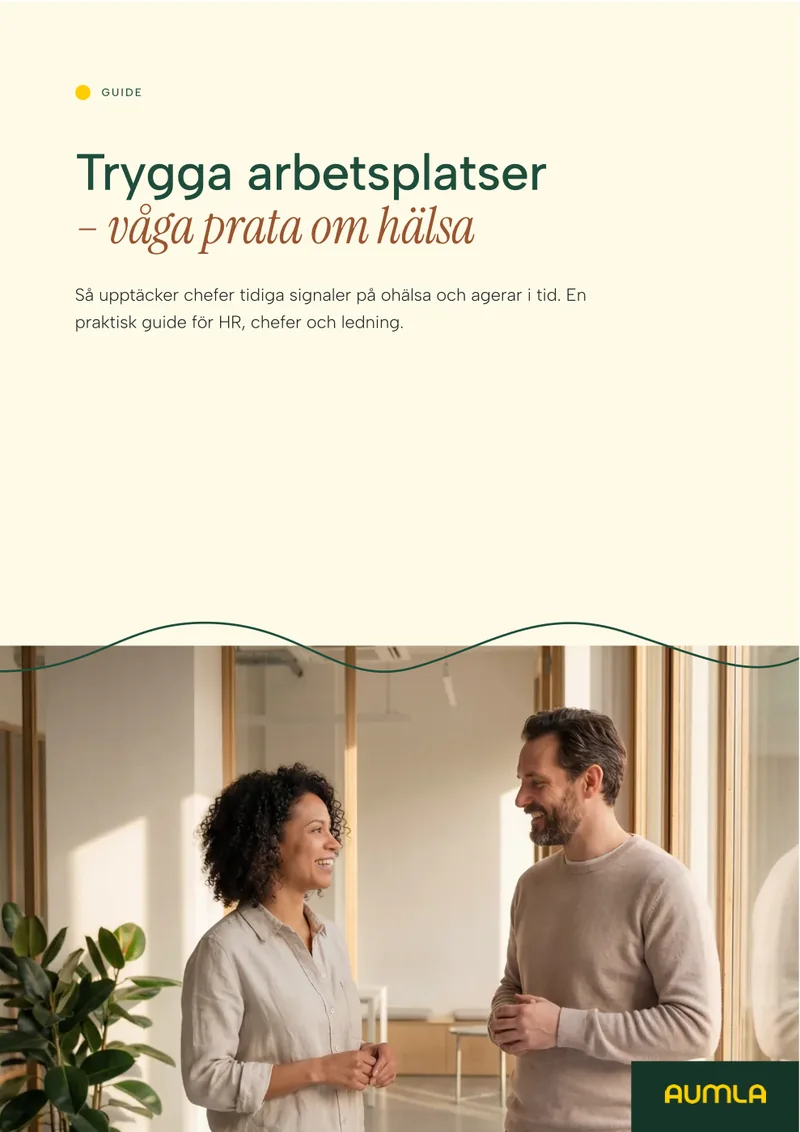
Guide
How to handle difficult conversations
How managers spot early signs of ill-health, dare to start the conversation and act in time (in Swedish).
FAQ
Frequently asked questions
What is OSA?
OSA is the Swedish Work Environment Authority’s rules on the organisational and social work environment, covering workload, working hours and victimisation, among other things. Employers are responsible for preventing unhealthy workload as part of systematic work environment management.
What can employers do about workplace stress?
Start with how the work is designed: demands, resources, priorities, meeting structure, availability and leadership. Individual tools can complement this, but rarely solve the root cause.
How do managers spot early signs of overload?
By knowing what to look for and feeling confident talking about stress and recovery – before it turns into sick leave. We train this in our Leadership for Sustainable Performance programme.
How do you follow up the impact?
We use your existing data and additional measurement to see where workload builds up, prioritise actions together with you and follow progress over time.
Book a strategic conversation
For HR, People & Culture and leadership teams. Tell us where you are today. Together we’ll review your situation, your data and the steps that will have the greatest impact – for both people and results.