Aumla Winning with Wellbeing
Billions of reasons to improve the work environment
Sick leave in Swedish municipalities and regions cost more than SEK 50 billion in 2023. Björn Cárdenas, strategist at the union Vision, on what lies behind it – and how health factors and systematic work environment management can turn the trend.
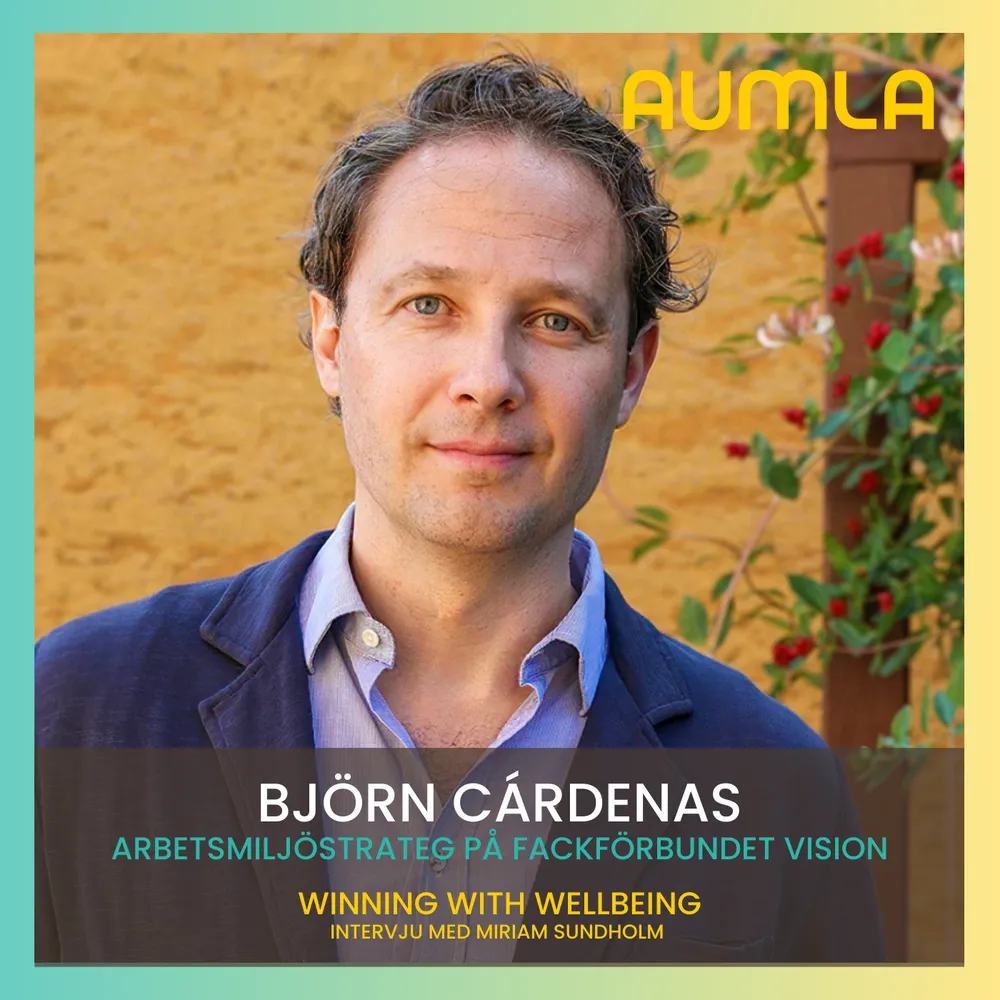
Björn CárdenasWork environment strategist, Vision
The conversation is in Swedish.
A report from five unions
Björn Cárdenas is a strategist at Vision with overall responsibility for the union’s work environment issues, and has previously been an elected representative, regional safety representative and union official. The report Billions of reasons to improve the work environment was published in June 2024 by five Swedish welfare-sector unions – Vision, Kommunal, Sveriges lärare, Vårdförbundet and Akademikerförbundet SSR – which together represent around 1.2 million employees.
The aim was to calculate what sick leave costs employers in municipalities and regions, and to show that a better work environment is a sound investment. The report counts not only sick pay but also lost production – and the figures are probably on the low side.
More than SEK 50 billion – and women are hit hardest
- Sick leave among employees in municipalities and regions cost more than SEK 50 billion in 2023
- Absence is at its highest level in ten years, excluding the pandemic years
- Women are affected far more than men
- Stress-related sick leave has risen sharply over the past decade
That money could instead have gone to better healthcare, social care and schools – and better conditions for those who work there.
You shouldn’t have to be a superhero to be a good manager. It’s about giving people the right conditions.
Why does it look like this?
Björn points to several causes:
- Knowledge at the top. Ultimate responsibility for the work environment lies with political leadership, which can change every four years. Inspections by the Swedish Work Environment Authority often find gaps in prevention and follow-up.
- Unequal conditions. Women-dominated services such as care and education often have weaker organisational conditions than male-dominated ones – even within the same municipality. A manager in elderly care can have 60–70 direct reports, while a manager in technical services has far fewer.
- Legislation with industrial roots. Physical risks have clear consequences and are strictly regulated. Stress and unhealthy workloads cause harm only over time – and are not enforced as firmly.
Health factors – not just risks
Traditionally, work environment management has focused on identifying risks. The unions and the employers’ organisations have now agreed on an initiative focused on health factors – what research shows makes workplaces healthier, such as clarity, support from managers, participation and a good social climate. The tools are freely available through Suntarbetsliv and work just as well in the private sector.
Miriam highlights the value of identifying what keeps people healthy: taking stock of what already works, keeping it – and seeing where conditions need strengthening, for example if managers lack time to drive work environment efforts.
OSA and systematic work environment management
Two sets of rules are central for every employer in Sweden:
- Organisational and social work environment (OSA) – covers workload, the balance between demands and resources, working hours and victimisation
- Systematic work environment management (SAM) – the method for continuously investigating, addressing and following up the work environment, rather than one-off efforts
Since this episode was recorded, the Swedish Work Environment Authority has restructured its regulations, and since January 2025 these requirements are gathered in AFS 2023:2.
According to Björn, the rules are fundamentally good – if everyone followed them fully, most stress-related problems would be solved. The gap is in application, often because managers and safety representatives lack time. With a continuous employee survey that picks up early signals, and managers and HR who analyse the results, an employer has come a long way.
Three ways forward
- Stable, long-term funding of welfare services – especially in women-dominated sectors
- Health factors at every workplace – from declaration of intent to action
- Clear consequences when OSA and SAM rules are not followed – just as with physical risks
Key takeaways
- Sick leave costs enormous sums – a better work environment is an investment.
- Women-dominated sectors often have weaker conditions and higher sick leave.
- Health factors complement risk management and apply to every sector.
- Systematic work and continuous measurement catch early signs.
- Managers need reasonable conditions to fulfil their work environment responsibilities.