Aumla Winning with Wellbeing
WELL certification – how workplaces build health, productivity and social sustainability
How does the work environment affect our health – and how does an organisation show it is serious about wellbeing? Lefteris Zacharakis, Nordics Regional Lead at the International WELL Building Institute, on the WELL standard, hybrid work and social sustainability.
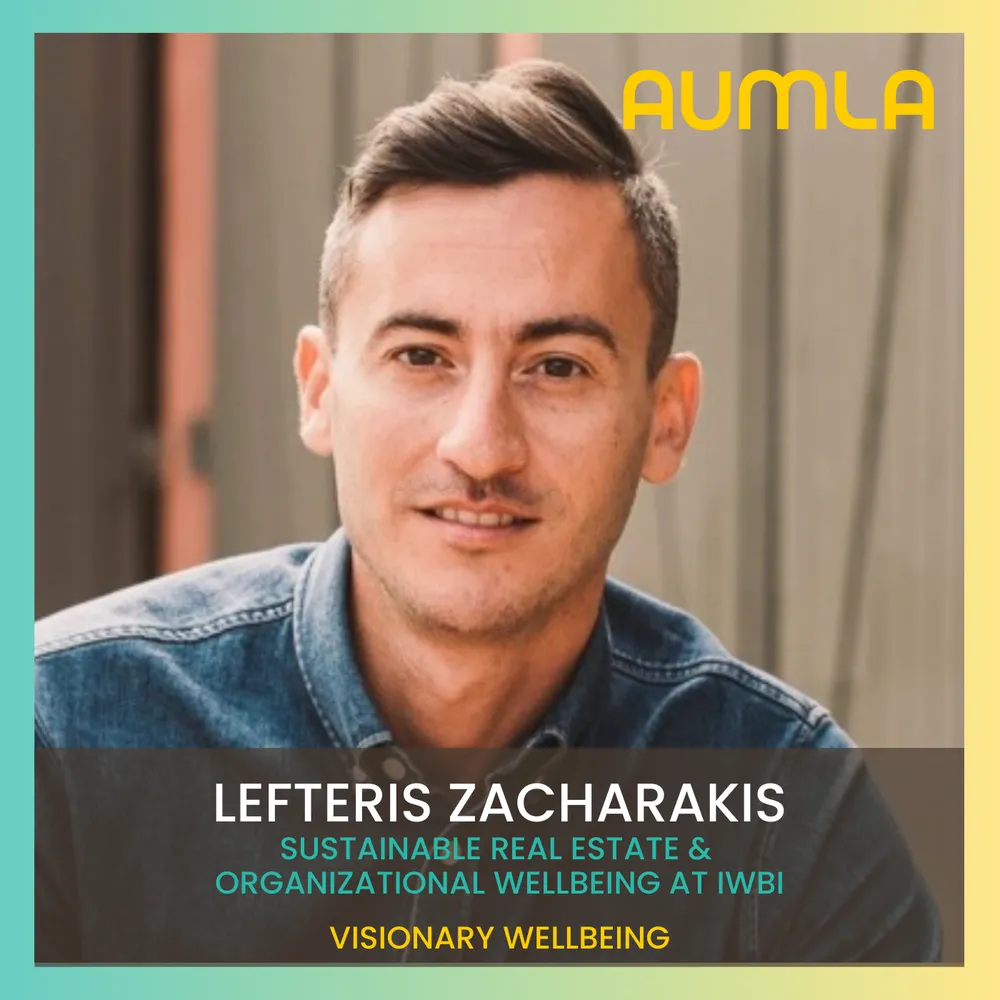
Lefteris ZacharakisNordics Regional Lead, International WELL Building Institute (IWBI)
The environment shapes health and performance
Lefteris Zacharakis has a background in engineering and environmental design and more than 14 years in real estate, in Sweden and the US. At the International WELL Building Institute (IWBI), he helps organisations in the Nordics work strategically with health and wellbeing through the WELL standard.
IWBI’s starting point is that the environments where we work and live affect our health, wellbeing and productivity. The WELL standard covers air, water, light, movement, comfort, mental health and community, among other areas.
Trends: health, flexibility and sustainability
Since the pandemic, Lefteris has seen organisations prioritise air quality, daylight and spaces that support mental health. Hybrid work is changing working life in several ways:
- Smaller, more flexible offices – more spaces for collaboration, with focused work often done at home
- Better balance – less commuting stress and more freedom, which matters for attracting and retaining talent
- Hiring from anywhere – more diversity, but a greater need to build cohesive teams
- Trust-based leadership – a focus on outcomes, and on belonging for both office and remote employees
Sustainability reporting drives change
Lefteris highlights the EU’s Corporate Sustainability Reporting Directive (CSRD) and the ESRS reporting standards as a driver for working with social issues in a structured way. IWBI has developed a tool that maps WELL strategies to the ESRS.
Since this episode was recorded, the EU has simplified the CSRD and its requirements now apply to the largest companies. But the questions increasingly reach suppliers through the value chain, and come from investors.
What matters most to measure
Physical: air quality and acoustics. Poor ventilation and high CO₂ levels cause fatigue and reduce cognitive function, while noise creates stress and breaks concentration.
Social: employee engagement and experience. Regular surveys and dialogue show where the organisation needs to improve – communication, flexibility or wellbeing initiatives.
Miriam includes questions on both the physical and the social work environment in her employee surveys – such as noise and temperature – because together they create the conditions for people to thrive and perform.
Human and social sustainability
- Human sustainability is about the individual – people not just coping at work but thriving physically, mentally and emotionally, and developing over time.
- Social sustainability is about systems – inclusion, equity, fair working conditions and the organisation’s contribution to society.
Both are needed for a sustainable workplace.
How WELL certification works
The WELL standard contains more than 100 evidence-based strategies. The process looks like this:
- Registration of the project with IWBI
- Assessment and planning against the standard, often led by a WELL AP (accredited professional)
- Implementation – in design, operations and organisational policies
- Verification by a third party, with on-site testing of air, water, light and thermal comfort, plus surveys on how employees experience the space
- Certification at bronze, silver, gold or platinum level – with recertification every three years
With WELL at scale, organisations can apply the standard across all their workplaces, not just one building.
Aumla as an Approved WELL Survey Provider
Aumla is approved by IWBI as a provider of the occupant surveys that are part of the WELL standard. Organisations working with WELL can get support from Aumla with surveys, analysis and year-on-year follow-up – and with turning the results into a wellbeing strategy.
Lefteris’s advice to employers
- Focus on health and wellbeing – fresh air, daylight, good workspaces and wellbeing programmes
- Be flexible – give people choice in how, when and where they work
- Build sustainability into everything – diversity, inclusion and community as part of the culture
- Listen – regular feedback keeps the workplace relevant
It’s one thing to claim something. It’s another to have gone through a rigorous process verified by a third party.
Key takeaways
- The work environment affects both health and productivity.
- Air quality, acoustics and employee engagement are among the most important things to measure.
- Sustainability reporting makes social issues strategic.
- WELL certification provides third-party verified proof that an organisation is serious about wellbeing.